

-
The power of simplicity: Lessons from unscripted Apple Immersive titles
Discover techniques on how to craft compelling, unscripted immersive stories. This session explores how to create natural, grounded framing, choose viewer-comfortable distances and heights, and use spatial audio to guide attention. You'll also learn why building trust with subjects is essential, especially when immersive shots are longer and place people at the heart of the experience.
This session was originally presented as part of the Meet with Apple activity “Create immersive media experiences for visionOS - Day 2.” Watch the full video for more insights and related sessions.资源
相关视频
Meet with Apple
-
搜索此视频…
Now, you may all be wondering, is her name really France? Yep. Sure is. France from France.
But the real question is what happens when you're not on stage with musicians? Not on a Hollywood film set or not able to use previews. Some of you here may be more familiar to Lena Cruz. Fewer cameras and a smaller set of resources. This is definitely the case of our team that's crafting unscripted stories for Apple Immersive videos. Typically, our sets look like this. We're out in the wild, oftentimes quite literally, and we film in less controlled environments.
We straddle the border of producing and just letting things happen. And this is a particularly delicate balance in immersive. Here are some of the immersive documentaries that we've produced. Our thinking was let's transport people places. Allow them to come face to face with some amazing creatures, and embark on unique adventures so that we would allow each viewer to become a visitor. And we were hoping that we would craft films not to be watched, but to be experienced.
But truth is, being there is not always enough. And our team has made some pretty amazing discoveries along the way, which I'd love to share with you today in hopes that it gives you a head start when it comes to crafting your own immersive stories. So we'll share some creative insights and try to root them in concrete production situations. But before we dive in, please remember it's a new medium. There is no established cinematic language, just some considerations that you might want to keep in mind before you hit the field. The first time we did so, let's say it like this. We traveled pretty light. Our main tool was a tripod, which, by the way, there's a fun fact about tripod in Immersive, it can easily make a cameo. Why? Because Apple Immersive is an amazing format that mimics a human eyes, so we pretty much capture everything from nine till three, but also a bit higher and lower than 12 to 6. So yeah, just make sure no leg will face the lens, put it toward the battery pack. But the good news is, even if you only have this grip tool, you can still capture beautiful Apple immersive stories. Because in immersive there is power and beauty in simplicity. And what could be considered a simpler kind of static shot in 2D linear will not totally feel static in the viewer's experience, because we filmed the world the way we see the world. And in fact, the camera is a viewer, don't you think? It looks kind of adorable with its two lenses? It's like it has two eyes. I love to say it looks like a cuter Wall-E.
And while it may doesn't have tools like interchangeable lenses or rack focus your viewers. They're the one we're going to be tilting, panning, or rack focusing on their own. Simply doing so by moving their heads and their eyes. And certain shots are particularly powerful in immersive like this one. The feeling of your subjects like this elephant here coming towards you, or even just moving around you is incredible.
And in fact, one of the most amazing things that we've heard from some folks after the experience series, like wildlife, is that they don't recall them as films that they watched. They remember them as memories.
Let's pull back the curtain on this shot. Well, there is beauty in simplicity. That doesn't mean capturing this shot is so simple because the camera is a viewer. You want to be intentional about where you're placing the viewer and therefore where you're placing. You got it. Your camera.
Well, there is no set rule. We can share some guidance when it comes to camera distance. About six feet away from your subject would be considered a comfortable distance and four feet away if you really want to feel close to your subject. See here. Our character is about to take her first dive with sharks. There's so much tension. You want to be close, but you don't want to be in her face either. Also, not so close that you can't see the sharks right here in the background.
So really in immersive, it's not just about getting a good shot, it's about what you filmmakers want your viewer to see and what you want your viewer to feel. And camera height contributes a lot to that feeling. Typically, the height we often use on tripod is about 50 to 60in about collarbone height of most humans. But let's look at this shot here. How high do you want your viewer to be? Do you want them to feel like they're sinking in the deep snow and bracing this extreme conditions? Or do you just want them to be at the exact height as one of your characters? These choices give you filmmakers agency to decide and to guide your viewers experience.
And while we don't have these interchangeable lenses in zoom, we can physically move our camera and decide on their position in relation to the subject and to the action. And at times, we even got a little bit too close. And it worked for a brief moment. In fact, that shot with the Rhinos broke all rules, but it turned out to be a fan favorite throughout our demos. Proof that I guess rules are meant to be broken, but with intention.
While there is a risk for some viewers to go cross-eyed, there is also a bigger risk for all viewers to kind of just reach their arms out and want to pet this chubby unicorns. So yeah, it's always a trade off.
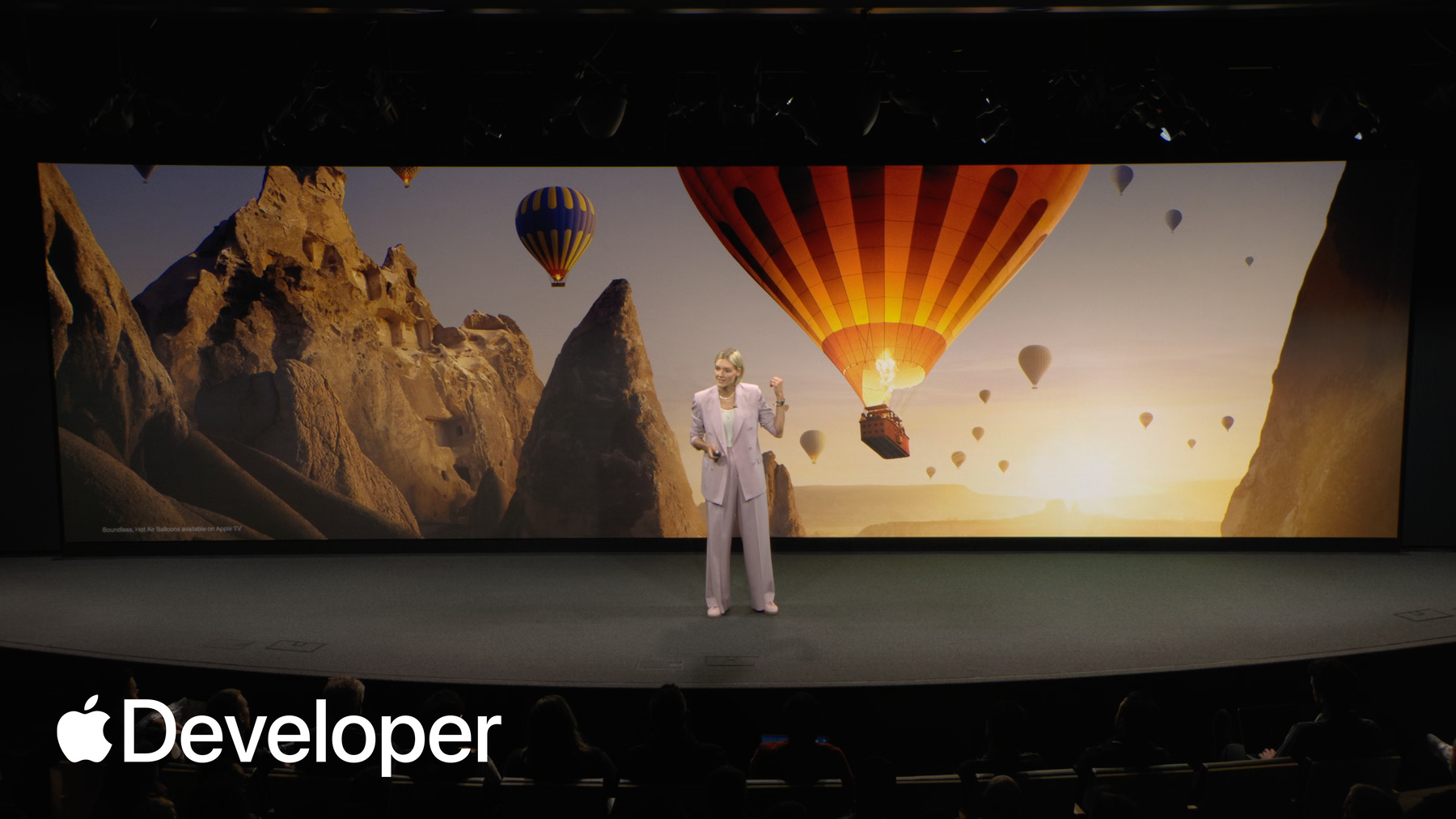
Same goes for camera framing. We film in uncontrolled environments, and sometimes things are just there without any ability for us to move them. So we just need to work around them. We filmed in a hot air balloon, and its basket structure was right on the edges of our frame. There is a risk of breaking stereo, and the basket structure will likely feel like it's sitting in your personal space. You can mitigate that by staying on the shot for a very brief moment, or making sure that your viewer's eyes may be attracted to something else, such as the face of the pilot or the fire of the burner.
Now, eventually, we experienced some camera movement. We had to experiment a lot, but we did so with intent. Usually we aim to keep it organic just simply to how we move as humans, unless we want to provoke a very unique reaction. In immersive. We simply can't go handheld. But even with linear resources, there are often efficient ways that you can mount your cameras on cars and cranes.
Movement helped us reinforce the feeling of presence. But we had to be mindful of the speed at which we were moving, of the direction at which we were going, and the stability of our movement. We even took our camera up in the air. We mounted it on drones or helicopter like this one. We also played with added slight up and down movement, filming from a bird's eye view or simply hovering over a scene. But what? Life doesn't totally love the sound of blade. And we know the power of being close to animals.
So our team crafted a cablecam rig to follow a young orangutan following their mothers up a tree. It took a lot of iterations and testing to define the right speed and ensure smooth movements, but it's one of the most powerful shots we've captured.
One take shots are so powerful and immersive, the viewer is just there, following the scene and experiencing something they would likely never be able to witness in real life. And while we certainly can't direct wildlife, we can help guide the gaze of our viewer, particularly in uncontrolled environment. In immersive, it's often less about directing your on screen subject and more about directing the viewer.
There is a lot of ways that you can direct your viewers experience without having to dictate it first by motivating what they see Well, there is a lot for your viewers to see in 180. This is an example of a clear element that your viewer will likely look at.
Some assumptions from 2D linear filmmaking don't totally translate into Apple Immersive Video format. For instance, some of you may choose to follow the rule of thirds, like I did this morning when I snapped this pic of the Apple Park coyote on my way to work.
You're placing your subject at the intersection of these two horizontal and two vertical lines. But in immersive there is something else. There is a whole new dimension. For example, here you would think this is a shot of a man drinking coffee.
But to many in immersive, it may actually come across as a shot of a plane sipping water, I guess.
Point is, in immersive we deal with a whole new depth. There is a foreground, a mid-ground and a background, and usually the best way for you to call attention to where you want your viewer's eyes is to do so by crafting what they hear.
A superpower of Apple Immersive Video is spatial audio, something that's really unique to our format, and it opens up creative storytelling opportunities.
Just listen to this.
Every sound is localized at the perfect distance of what you see. The waves, the wind, the seagulls. Sound is crucial in immersive storytelling. Not only does it make you feel there, but it makes you look there at specific elements, which we can then use as cutting points to create organic transitions and a highly cinematic storytelling.
Pristine silence was also pretty epic in the balloon, only punctuated by the outburst of the fires from the burner.
Audio truly adds up to the dynamic of immersive experiences, but it's also a fantastic way to create an intimate scene, like this moment where the caregiver whistled to this elephant, or when he decided to explain something to the viewers, pointing at a specific feature of an elephant. It's a real moment of authenticity and the kind of experience you only get to experience in immersive.
But not all our experiences were character driven. In fact, for elevated series, we don't have a character at all. We basically step inside an Apple screensaver and we fly over the most majestic vistas.
For some of the episodes, we had to write narration directly, calling attention to certain elements in the frame so we could continue to immerse the viewer, which is my last and maybe most important creative insight. We always hope that the viewer will ultimately forget about the technology and truly immerse in the story, even if that's quite literal, like when we went underwater with sharks or when an orangutan. Get ready. Poke the eye of the viewer.
Immersive is an experience, and what or who you decide to put in front of the camera will ensure that the experience is not just transporting, but also transforming.
Your setting matters. The place where you're filming, the time of the day, or really just a shot that simply reminds you of the way you would experience a new country. Overall, it's about creating the right atmosphere for your story and your character becomes guide. Their casting is key. Most of the time we fill them full body so every detail can be noticed. If they feel a bit nervous, the foot twitching that may become all your viewers will stare at. So you must establish a strong relationship of trust to have characters comfortable and compelling on camera.
You also don't want to have the contrary. With an overconfident talent like this overeager salesperson stuck in front of your face, constantly interacting with you.
So we tend to direct them less than in traditional 2D documentary, where we cut between camera angles and edit sequences with close ups. Characters will be on screen for longer. Each shot kind of tends to last longer, so you really want them to be people you want to hang with, even if they're about to surf in frigid water. Here we experimented with filming portrait, which felt like a different creative choice in immersive. We had a clear intent, so a lot rests on your character. In immersive. There are guides for the audience. They're experts and they need to pick our curiosity. You want the right person and the right voice. But at times you don't even need their voice at all. Because in immersive, we connect to people in a unique way and we share more than a space together. We share moments like this free diver here about to break a world record under the ice. And traditionally in traditional storytelling, we often speaks in acts and scenes, but some things are unique to immersive or moment moments to immerse where we lean on not forcing anything, just letting emotions run. Moments that viewers can simply soak in and take their time to fully appreciate. That one was all about tension and silence, but we can also be fun in immersive, which we did in our film. We let them interact, stare directly into the eyes of the viewers, and also just letting them be Zombie orangutans. And if you watch the film, there is a section that demonstrates their playful nature. That moment was found in post, while immersive, requires all of us to have this robust pre-production plan and to really try to anticipate as much as possible. We love to keep room for creativity in post. Actually, there is no real fix it in post in immersive. There is not even third party stock footage. Doesn't exist as of now, but we can leave the door open to finding new creative, immersive ways to tell stories in post, because that's very often where it all comes together. And on that note, it is my pleasure to introduce you to Tim Amick, our head of post-production, to go over lessons in presence and post-production. Thank you.
-